
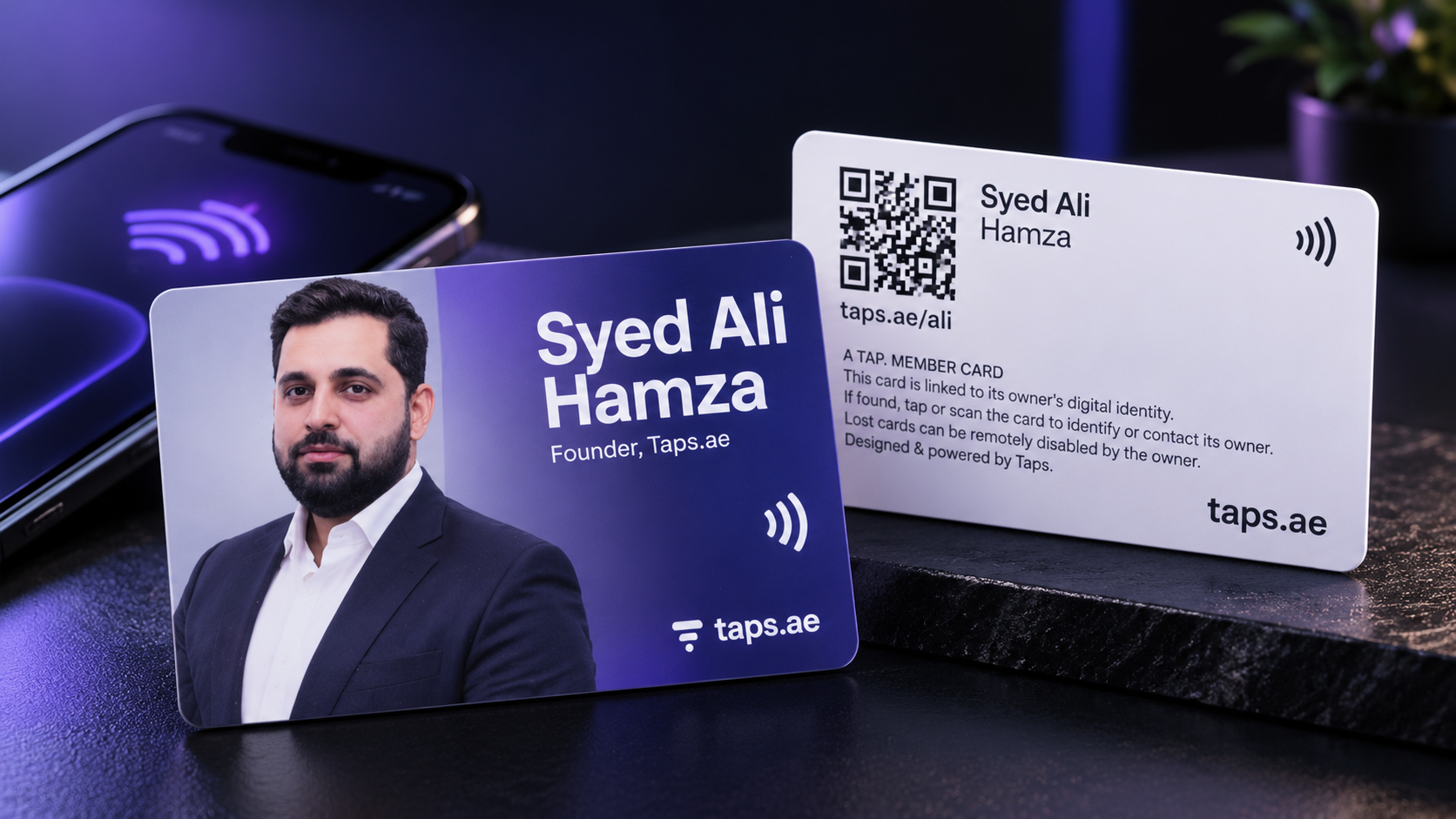
An NFC Business Card UAE professionals can use today looks almost like a normal business card, but the way it shares information is completely different. Instead of handing someone a printed card and hoping they keep it, you simply bring the card close to their phone and your digital profile can open within seconds.
For people constantly meeting clients, attending exhibitions, selling property, running businesses or building professional connections across Dubai, Abu Dhabi, Sharjah and the rest of the UAE, that can make networking much easier.
But NFC cards also attract plenty of hype.
Are they genuinely useful? Do they work with normal smartphones? Does the other person need an app? Can you update your information later? And is an NFC business card actually worth paying for?
Here is what you should know before making the switch.
What Is an NFC Business Card?
NFC stands for Near Field Communication.
It is the same basic type of short-range contactless technology people already encounter when using contactless systems.
According to the NFC Forum, NFC works over a very short distance and can trigger actions such as opening an internet address when a compatible device reads an NFC tag. NFC tags can also be passive, meaning the tag itself does not normally require its own battery.
For a digital business card, the concept is simple.
A tiny NFC chip is embedded inside the physical card.
That chip can contain a web address.
When someone brings an NFC-enabled smartphone close to the card, the phone reads that information and can open the linked digital profile.
So the card itself does not need to contain your entire professional life.
It only needs to connect the phone to it.
How Does an NFC Business Card UAE Professionals Use Actually Work?
The normal experience takes only a few steps.
Step 1: Tap the Card
You place the NFC card close to the compatible smartphone’s NFC reading area.
Because NFC works across only a very short distance, the phone and card normally need to be physically close.
Step 2: The Phone Reads the NFC Tag
The NFC chip contains data such as the address of your digital profile.
Modern NFC systems can read URL information stored using standard NFC data formats. Android’s official NFC documentation, for example, explains how NFC tags containing URI information can be detected and handled by compatible devices.
Step 3: The Digital Profile Opens
The recipient opens the notification or link.
Your digital profile then appears in their browser.
Depending on the platform you use, that profile can contain much more than a traditional business card.
Step 4: The Person Takes Action
Instead of manually typing your number, they may be able to:
- Call you
- Open WhatsApp
- Send an email
- Visit your website
- Open your location
- View social profiles
- Save your contact
- Scan or share a QR code
That is where an NFC business card becomes more useful than simply placing your phone number inside a chip.
What Information Can an NFC Business Card Share?
Technically, an NFC tag can trigger different types of data and actions. The NFC Forum lists examples including web addresses, phone numbers, email addresses, locations and contact information.
For business cards, however, linking to a digital profile is usually more flexible.
Imagine printing all of this on a physical card:
Name
Job title
Company
Phone
WhatsApp
Email
Website
LinkedIn
Instagram
Office address
Google Maps location
Portfolio
Booking link
The result would be a mess.
A digital profile can organise those details properly while the physical NFC card remains clean.
A Real Example: How Taps Uses NFC
A good example of this model is Taps, a UAE-focused smart profile platform.
Instead of storing your entire professional profile directly on the physical card, Taps gives you one public digital profile that can be shared through an NFC card, QR code or URL.
A Taps profile can include contact details, business information, WhatsApp, phone, email, social profiles, websites, locations and custom links. The platform also says recipients do not need to install an app simply to open the profile.
So the process becomes:
Tap card → Open profile → Choose an action
That is much easier to understand than treating an NFC card as a complicated piece of technology.
NFC Business Card UAE vs Traditional Business Card
The biggest difference is not actually NFC.
It is what happens after you meet someone.
| Traditional Business Card | NFC Digital Business Card |
|---|---|
| Information is printed | Information can live online |
| Details become outdated | Profile details can be updated |
| Recipient keeps physical card | Recipient can save details immediately |
| Limited space | Can contain multiple actions and links |
| No interaction data | Some platforms provide analytics |
| Requires reprinting after changes | Same physical card can continue pointing to an updated profile |
| Mainly one-way sharing | Some platforms can also collect visitor details |
A paper business card still has advantages.
It requires no phone.
It is cheap.
People understand it instantly.
And a well-designed premium card can create a strong physical impression.
The better question, therefore, is not necessarily:
“Should NFC replace paper?”
It is:
“Which format works better for the way I actually meet customers?”
Why NFC Business Cards Make Sense in the UAE
The UAE is a particularly logical environment for this type of product.
Professionals regularly meet people through:
- Business exhibitions
- Property launches
- Conferences
- Networking events
- Client meetings
- Trade shows
- Clinics
- Hotels
- Restaurants
- Sales visits
- Startup events
Now imagine meeting 30 people at an exhibition.
With traditional cards, you might hand out 30 pieces of paper.
You do not know how many will eventually be used.
With an NFC profile, the interaction happens directly on the other person’s phone.
That does not guarantee a lead.
But it removes one unnecessary step between meeting someone and connecting digitally.
Benefit 1: You Can Update Your Information
This may be the biggest practical advantage.
Suppose you print 1,000 traditional cards.
Two months later, you change your:
- Mobile number
- Company
- Job title
- Website
- Office
- Instagram account
Your printed cards now contain outdated information.
With a digital-profile NFC card, the physical card can continue opening the same profile URL while the information displayed on that profile changes.
You update the profile rather than printing another batch of cards.
For people who regularly change projects, links or professional information, that is useful.
Benefit 2: One Card Can Hold Much More Than Contact Details
A traditional visiting card usually gives someone:
Name.
Company.
Phone.
Email.
Maybe a website.
An NFC profile can create a much richer experience.
For example, a real estate agent might share:
- Phone
- Property website
- Current project link
- Office location
A consultant might share:
- Contact information
- Company website
- Portfolio
- Consultation booking link
The card becomes a doorway rather than the destination.
Benefit 3: No More Typing Phone Numbers
This sounds like a small improvement until you watch people exchange contact details.
“What’s your number?”
“050…”
“Sorry, 050 or 055?”
Then someone sends a WhatsApp message saying:
“Hi, Ali here.”
Digital business cards remove much of that friction.
A button can open WhatsApp.
Another can initiate a call.
Another can save contact information.
Small improvements matter when you repeat an action hundreds of times.
Benefit 4: NFC and QR Can Work Together
NFC does not need to be your only sharing method.
In fact, using NFC and QR together is often better.
Taps, for example, supports sharing through a Taps URL, QR code or NFC card.
That gives you three options:
Tap the NFC card.
Scan the QR code.
Send the URL.
If one method is inconvenient, another is available.
This is much more practical than building the entire experience around one technology.
Benefit 5: No App Requirement Makes a Big Difference
Imagine meeting a potential customer and saying:
“Download this app first so I can give you my business card.”
Most people will not do it.
A good digital card experience should require as little effort as possible from the recipient.
Taps specifically states that its profile sharing requires no app for the person opening the public profile.
That is important.
The person taps.
The profile opens in the browser.
They decide what to do next.
Benefit 6: Digital Business Cards Can Generate Leads
A traditional business card normally works in one direction.
You give someone your details.
They walk away.
You may never know who they were.
Digital profiles can potentially change that interaction.
Taps currently includes a “Share your details” function on its public profile experience.
That creates a different possibility:
You share your profile.
The visitor decides to share their details back.
Now the networking interaction can become a lead rather than only a one-way information exchange.
For sales teams, property agents, consultants and business-development professionals, that can be significantly more valuable than simply handing out a card.
Benefit 7: Analytics Tell You What People Actually Use
Paper cards cannot tell you anything after you hand them out.
You do not know whether someone:
- Looked at your website
- Opened WhatsApp
- Saved your contact
- Viewed your location
Digital profiles can.
Taps, for example, says its analytics can show profile views, action taps, top-performing links and the source visitors came from.
This does not mean every tap becomes a customer.
But it gives professionals information a paper card simply cannot provide.
Who Should Consider an NFC Business Card UAE?
Not everybody needs one.
But there are several professions where the format makes obvious sense.
Real Estate Agents
Agents constantly exchange numbers, WhatsApp details, project links and social profiles.
Instead of giving a prospective buyer five different links, one digital profile can organise them.
Sales Professionals
If your job involves meeting new people every day, reducing the time required to exchange information can be valuable.
Business Owners
A founder can connect their personal identity with their company website, WhatsApp, location and social presence.
Consultants and Freelancers
Your card can become a small professional landing page containing your portfolio, services and contact actions.
Doctors and Clinic Professionals
Professional profiles can make clinic location, contact details and booking routes easier to access, while sensitive information should still be handled according to appropriate privacy requirements.
Creators
Creators often need to share multiple social platforms, websites and collaboration details.
Exhibition Teams
Companies attending UAE exhibitions can equip team members with reusable cards instead of continuously printing large quantities of temporary cards.
Problems With NFC Business Cards You Should Know About
NFC cards are useful.
They are not magic.
There are real limitations.
Problem 1: The Tap Position Can Be Confusing
The NFC reading area is not in exactly the same physical position on every phone.
Someone unfamiliar with NFC may tap the middle of the screen when the reader is actually elsewhere.
Usually this is solved by moving the card around the upper or rear area of the phone until it detects the tag.
After someone has done it once, the interaction is normally much easier.
Problem 2: Not Every Phone Experience Is Identical
NFC behaviour can depend on:
- The phone
- Operating system
- Device settings
- NFC capability
- How the NFC tag is configured
Android documentation notes that NFC-capable devices handle discovered tags through the operating system’s tag-dispatch system.
For this reason, providing a QR code alongside NFC is sensible.
Problem 3: A Web Profile Usually Needs Internet Access
The NFC interaction itself can identify the link without the card needing its own internet connection.
But if the NFC card points to an online digital profile, the phone needs connectivity to load that website.
Inside the UAE this is rarely surprising, but it is still an important distinction.
NFC does not magically store your entire online profile inside the physical card.
Problem 4: A Cheap NFC Card and a Good NFC Platform Are Not the Same Thing
You can buy an NFC chip and write a URL onto it.
That does not automatically give you a good digital business-card system.
The real product includes what happens after the tap:
- Profile design
- Mobile performance
- Contact saving
- Privacy controls
- Analytics
- Lead collection
- QR sharing
- Link management
- Reliability
The plastic card is only one part of the experience.
Problem 5: Privacy Still Matters
Putting every personal detail publicly online is not automatically a good idea.
Users should have control over what appears publicly.
Taps, for example, says phone, email, WhatsApp and location information remain private until the profile owner chooses to display them.
That is the right principle.
Digital convenience should not mean publishing information you intended to keep private.
Is an NFC Business Card Secure?
NFC itself is a very short-range technology. The NFC Forum describes it as operating only across very close proximity, which is part of what makes tap-based interactions practical.
But card security depends on how the NFC product is implemented.
Simple NFC tags can be writable, while some can be configured with read-only or one-time-programmable areas. Android’s official NFC documentation acknowledges both writable tags and tags that can be configured for read-only use.
This is worth checking with any NFC-card provider.
If you are purchasing cards for a company, ask:
- Can the NFC destination be rewritten?
- Can the tag be locked?
- Who controls the profile URL?
- Can a lost card be disabled?
- Can employee profiles be managed centrally?
- What happens if an employee leaves?
Those questions become increasingly important when NFC cards are deployed across a team rather than used by one person.
NFC Business Card UAE: Is It Actually Worth It?
For some people, absolutely.
For others, probably not.
If you rarely meet new people professionally, a normal business card might be enough.
But if you regularly:
- Meet clients
- Attend exhibitions
- Sell face-to-face
- Network
- Give presentations
- Visit properties
- Attend business events
- Exchange WhatsApp details
then an NFC card can remove a lot of repeated friction.
The value is not that the card contains futuristic technology.
The value is that the interaction becomes easier.
Tap → Profile → Connect
That’s the part that matters.
NFC Business Card vs Paper Card: Which Should You Choose?
You do not necessarily have to choose only one.
A smart strategy can be:
NFC card for yourself
plus
a small number of traditional cards as backup
The NFC card becomes your everyday networking tool.
Traditional cards remain available for someone who prefers paper or does not want to use their phone.
Technology works best when it gives people another option rather than forcing them into one.
What Should You Look for Before Buying an NFC Business Card?
Do not choose based only on how the physical card looks.
Check the platform behind it.
Look for:
- A fast mobile profile
- No app requirement for visitors
- Editable information
- QR backup
- Easy contact saving
- WhatsApp integration
- Privacy controls
- Analytics
- Lead collection
- Secure account access
- Reliable hosting
- Ability to update links
- Future team management if required
The NFC chip itself is relatively simple.
The software experience is what determines whether you will actually continue using the card.
A UAE Example: Taps
Taps has taken this approach by building the digital profile first and making NFC one of several ways to access it.
Its current profiles can combine identity information, business details, WhatsApp, phone, email, social profiles, websites, locations and custom links. Users can share the profile through a URL, QR code or NFC card.
Taps also currently highlights privacy controls and analytics, while its upcoming Taps Pro offering is planned to add features such as advanced analytics, custom domains, team management, NFC card programs and branding controls.
That broader approach matters because the future of digital business cards is probably not about the card itself.
It is about having one professional identity that works everywhere.
You can explore Taps at Taps — Smart profiles for UAE professionals.
Why This Matters Beyond Business Cards
The traditional business card solved one problem:
“How can I give you my contact details?”
Modern professionals have a more complicated problem.
They may want to share:
- Portfolio
- Company website
- Location
- Booking page
- Phone
The business card is evolving from a piece of paper into a gateway to that digital identity.
NFC simply makes opening it faster.
For businesses considering how their website, digital identity and customer journey fit together, explore The Triump for digital strategy, websites and online experiences.
Frequently Asked Questions About NFC Business Cards in UAE
What is an NFC business card?
An NFC business card contains a short-range NFC tag that can share information with a compatible smartphone. It commonly stores a link that opens a digital professional profile.
Does an NFC business card need a battery?
Passive NFC tags normally do not require their own battery. The NFC Forum explains that passive tags can receive the small amount of power required for interaction from the reading device.
Does the other person need an app?
It depends on the provider.
For a web-based platform such as Taps, the recipient does not need to install an app just to open the public profile.
Can an NFC business card work with a QR code?
Yes.
Many digital-card systems use NFC and QR together. Taps, for example, allows profiles to be shared using NFC, QR or a normal URL.
Can I change my phone number later?
If your NFC card points to an editable online profile, you can change information on that profile without necessarily replacing the physical card.
That is one of the main advantages over printed business cards.
Can NFC cards store my contact directly?
NFC standards can support contact information, URLs and other types of data.
However, many modern digital business cards use the NFC chip primarily to open an online profile because the profile provides more flexibility and can be updated later.
Can someone rewrite my NFC card?
Some NFC tags are writable.
Others can be configured or permanently locked as read-only, depending on the tag and implementation.
Ask your provider how its cards are configured before ordering.
Are NFC business cards only for companies?
No.
They can be useful for individuals, freelancers, creators, salespeople, real estate agents, consultants and other professionals.
Can an NFC business card replace printed cards completely?
It can for many users, but keeping a few printed cards as backup can still make sense.
The Final Verdict
So, is an NFC Business Card UAE professionals should actually consider?
For anyone who networks regularly, yes.
Not because NFC itself is revolutionary.
The technology has existed for years.
What has changed is what can happen after the tap.
Instead of giving someone a piece of paper containing five lines of information, you can give them access to an updated professional profile containing your contact actions, social presence, website, location and other important links.
Platforms such as Taps take that further by combining NFC, QR codes, digital profiles, privacy controls, contact saving, lead exchange and analytics into one experience.
For someone who exchanges contact details twice a year, that might be unnecessary.
For someone meeting customers every week, it can be genuinely useful.
The best way to think about an NFC business card is therefore not:
“This is a high-tech business card.”
Think of it as:
“This is one reusable shortcut to my entire professional identity.”
And in a market as connected and relationship-driven as the UAE, that is where the idea starts to make sense.
For independent technical information about how NFC itself works, see the official NFC Forum guide to NFC technology.
