
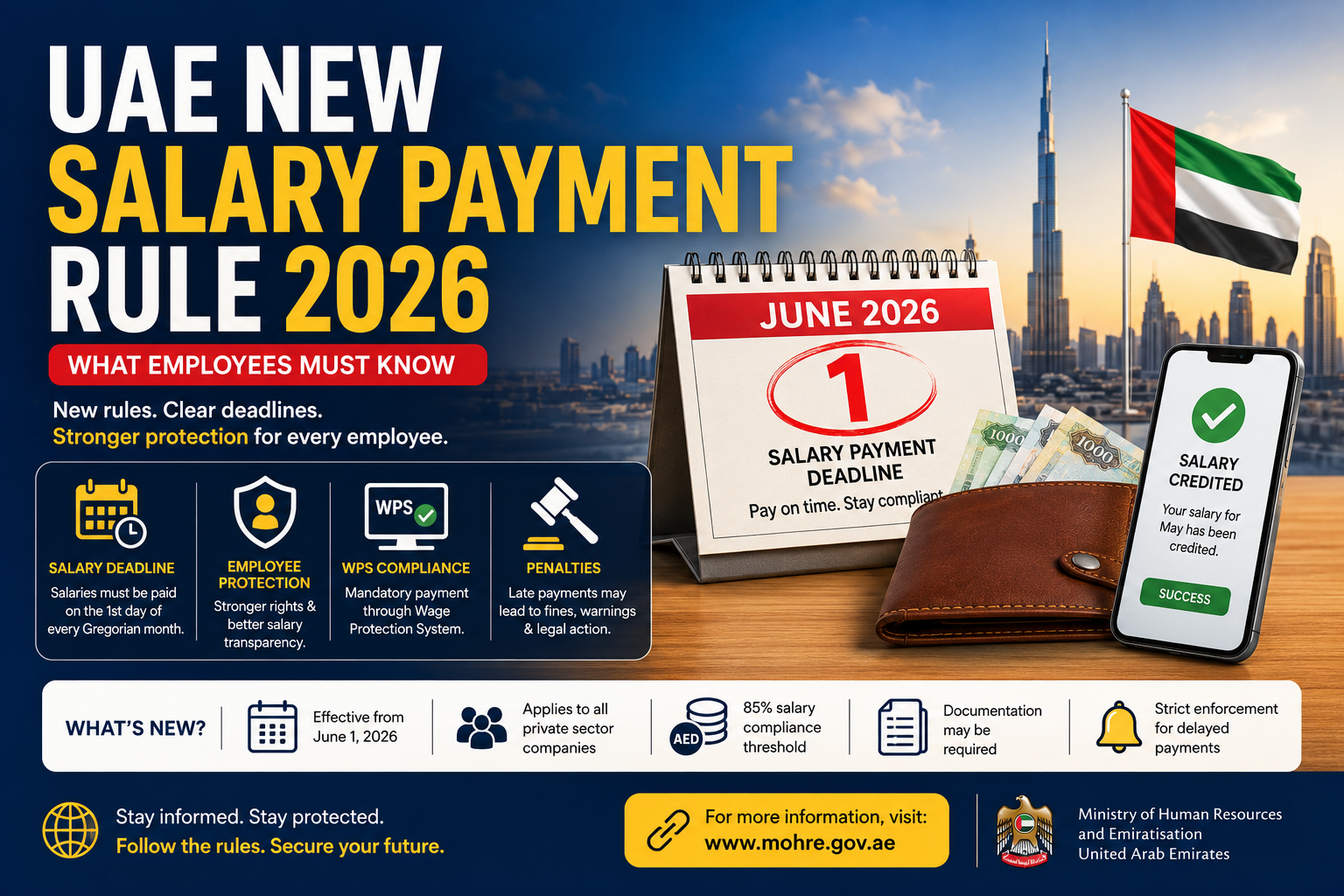
The UAE New Salary Payment for private sector companies. Starting from June 1, 2026, employers must follow stricter wage payment regulations under the updated Wage Protection System (WPS).
The new regulation aims to improve salary transparency, strengthen employee protection, and ensure workers receive their salaries on time. The changes affect all private sector companies registered with the Ministry of Human Resources and Emiratisation (MOHRE).
If you work in the UAE or own a business, understanding the UAE New Salary Payment Rule 2026 is important.
What Is the UAE New Salary Payment Rule 2026?
Under the new Wage Protection System regulations, private sector employers must pay salaries for the previous month on the first day of every Gregorian month. Any payment made after the due date is officially considered delayed.
For example:
- May salary must be paid on June 1
- June salary must be paid on July 1
- July salary must be paid on August 1
This creates a standardized salary payment schedule across the UAE private sector.
When Does the New Salary Rule Start?
The updated salary payment regulations officially take effect on:
June 1, 2026
From this date, all eligible private sector companies must comply with the revised Wage Protection System requirements.
Why Did UAE Introduce This Rule?
The UAE government introduced the new salary payment framework to:
- Protect employee rights
- Improve salary transparency
- Increase employer compliance
- Reduce delayed wage payments
- Strengthen labour market stability
The Ministry of Human Resources and Emiratisation stated that the new system helps create a more organized and transparent salary payment process.
Wage Protection System (WPS) Requirements
All private sector companies covered under MOHRE regulations must pay salaries through:
- Wage Protection System (WPS)
- Other MOHRE-approved payment systems
Employers may also be required to provide documentation proving salaries were paid according to regulations.
Learn more from the official UAE government portal:
New 85% Salary Compliance Threshold
The updated rule introduces a new compliance threshold.
A company will generally be considered compliant if:
- At least 85% of total wages are paid on time
- Individual employees receive at least 85% of their salary
The remaining amount must relate to legally documented deductions permitted under UAE Labour Law.
What Happens If Employers Delay Salaries?
The UAE has introduced a stricter enforcement process for late salary payments.
Possible actions may include:
- Electronic warnings
- Work permit restrictions
- Company downgrades
- Administrative penalties
- Labour disputes
- Legal action in serious cases
The enforcement process escalates based on the duration of non-compliance.
How Will This Affect Employees?
For employees, the new salary payment rule provides greater protection.
Benefits include:
- Clear salary deadlines
- Improved wage transparency
- Better salary tracking
- Faster action against delayed payments
- Stronger labour protections
Employees working for companies that already pay salaries on time may notice little change. However, workers affected by delayed salaries could benefit significantly from the new regulations.
How Will This Affect Employers?
Businesses may need to update:
- Payroll systems
- Salary processing schedules
- Internal accounting workflows
- Compliance procedures
Companies that traditionally process salaries later in the month may need operational adjustments to meet the new deadlines.
Is There a New Minimum Salary in UAE?
Many people are confusing the new salary payment rule with a minimum wage law.
Currently:
- The UAE does not have a universal minimum wage for all private sector employees.
- Salaries are generally determined through employment contracts.
- A separate minimum salary framework applies to Emirati nationals working in the private sector under Emiratisation policies.
So the new rule mainly focuses on salary payment timing and compliance, not a nationwide minimum wage.
Common Questions About the New UAE Salary Rule
Will all companies need to pay salaries on the 1st?
Yes, salaries for the previous month become due on the first day of the following Gregorian month under the updated WPS framework.
Does the rule apply to private companies?
Yes, the regulation applies to private sector companies registered with MOHRE.
Can employers still use WPS?
Yes. WPS remains the primary salary payment system under the new framework.
What This Means for UAE’s Labour Market
The new salary payment framework represents one of the most significant wage compliance updates in recent years.
The regulation is expected to:
- Improve worker confidence
- Strengthen labour protections
- Increase payroll transparency
- Improve employer accountability
- Support labour market stability
The UAE continues to modernize employment regulations while improving worker protections and compliance standards.
Final Thoughts
The UAE New Salary Payment Rule 2026 introduces stricter salary payment deadlines for private sector employers.
Starting June 1, 2026:
- Salaries must be paid on the first day of each month
- Payments must comply with WPS requirements
- Delayed payments may trigger penalties
- Employees receive stronger salary protections
Both employers and employees should understand these changes to ensure compliance and avoid future payroll issues.
For official updates and labour regulations, visit:
